
Long the Stack: Why I’m Super Long AI Infrastructure

There are a lot of ways to be long AI right now. You can try to pick the model lab that wins, and probably be wrong, or you can be long the physical buildout: the chips, the fabs, the substations, the cooling loops, the fiber, the racks. My bet is the second one.
I’m not trying to predict which model, lab, or application dominates the next decade. I’m trying to own the choke points that every winner has to pay. That means focusing on layers where supply is constrained, and where pricing power tends to survive even when individual winners change.
The goal is simple: own the parts of the AI stack where supply can't easily catch up with demand. The stronger the bottleneck, the bigger the position.
By bucket: Compute 25%,Power 19%, Semicap 17%, Hyperscalers 16%, Data Center 11%, Networking 4%, Memory 3%, AI Software 3%, Cybersecurity 2%.
Let me walk through the logic layer by layer.
1. Compute (25%): NVDA, AVGO, TSM, AMD

This is the biggest bucket, which makes sense: AI runs on chips, and the chip layer is where demand shows up first. What’s more interesting is how the bucket is split. I’m deliberately not betting only on NVIDIA. The thesis is that the category keeps growing even if NVIDIA’s pricing power gets squeezed over the next two or three years as alternatives emerge.
NVDA (8%) is still the dominant player in AI chips. Their newest generation (Blackwell) is ramping, their software platform (CUDA) has become the default that every AI developer builds on, and they now sell full server racks instead of just chips, which captures more of the value chain.
AVGO (7%) is my highest-conviction name in compute. Broadcom does two things that matter. First, when Google or Meta want to design their own AI chips instead of buying from NVIDIA, Broadcom is the partner that helps them build it. Second, Broadcom makes the high-end networking gear that connects AI chips inside a data center, which gets more valuable as AI clusters grow. Either way the AI buildout plays out, Broadcom gets paid.
TSM (7%) is the company that physically manufactures essentially every advanced AI chip in the world, including NVIDIA’s, AMD’s, and Broadcom’s. Nothing in this portfolio gets built without them. The specific bottleneck right now is “CoWoS,” the manufacturing step that packages an AI chip together with its memory. TSMC has no real competition at the leading edge for the rest of this decade. The Taiwan/China risk is real but already reflected in the stock price.
AMD (3%) is a small bet on AMD eventually becoming a real second source to NVIDIA. Their AI chips (MI300, MI325) are shipping but in lumpy volumes. I keep this small because winning here requires not just competitive hardware but also a competitive software stack, and getting the AI ecosystem to support AMD’s software as fluently as NVIDIA’s is a multi-year project.
2. Power (19%): ETN, GEV, CEG, VST
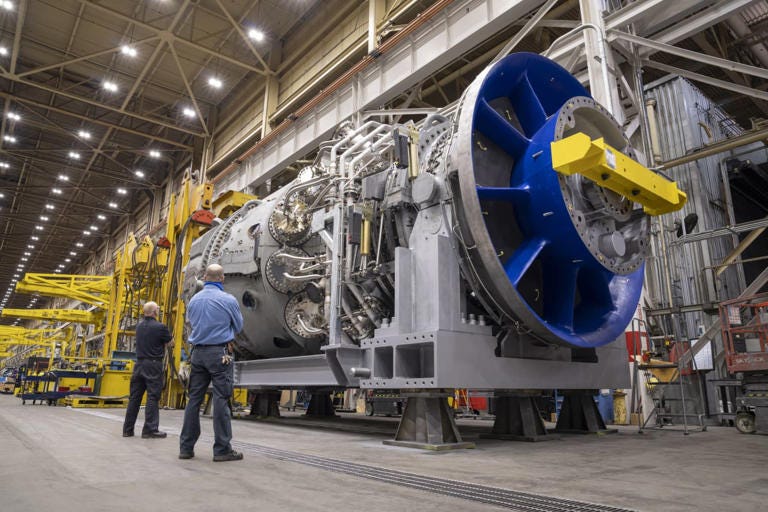
This is the most contrarian part of the portfolio relative to consensus and, in my view, the most important. The bottleneck on AI’s growth over the next five years isn’t chips. It’s electricity, specifically, the kind that’s available 24/7 and located near regions with enough power lines to actually deliver it. Every time a hyperscaler announces a major new data center, a power deal or a nuclear restart headline follows within weeks. That’s not a coincidence.
The structural problem is simple: a single AI training cluster now needs a gigawatt of power, roughly the output of a large nuclear reactor, and hyperscalers want these clusters online in 18 months. But the US grid takes seven to ten years to permit and build new power plants. The math doesn’t work. So the system has to clear in four ways: (a) build natural gas plants as fast as possible, (b) restart and extend the life of existing nuclear plants, (c) install very expensive grid-scale batteries, and (d) pay premium prices for reliable, contracted power. Each of these has a publicly traded beneficiary.
ETN (5%): Eaton makes the electrical equipment that connects power plants to data centers: switchgear, transformers, the busways that distribute power inside a building. Their order backlog has been at record levels for six straight quarters, and wait times for medium-voltage transformers are now 18 to 24 months.
GEV (5%): GE Vernova is two bets in one. It’s the biggest maker of heavy-duty gas turbines (the engines inside natural gas power plants), and that backlog is sold out through 2028. It also makes the grid equipment needed to move power around at high voltage.
CEG (5%): Constellation Energy owns the largest fleet of nuclear power plants in the US. The Three Mile Island restart with Microsoft is the template: a hyperscaler signs a long-term contract to take all the power from a specific reactor at a premium price, for the next decade or two. More of these deals are coming. CEG’s existing fleet effectively becomes a set of inflation-protected long-term contracts.
VST (4%): Vistra is the more cyclical version of CEG, with both nuclear and gas plants. Lower-quality business but cheaper, and with more upside if electricity prices rise in Texas and the mid-Atlantic grid (the regions where data center demand is growing fastest).
3. Semicap (17%): ASML, AMAT, LRCX, KLAC
“Semicap” is short for semiconductor capital equipment: the machines that make chips. If compute is where AI money first lands, semicap is where it lands before that: every advanced AI chip requires the chip factories (TSMC, Samsung, Intel) to buy more of these machines, generation after generation. Four companies dominate this market, and ASML has an outright monopoly on the most critical machine of all.
ASML (6%) makes the EUV (extreme ultraviolet) lithography machines that print circuit patterns onto chips. Each new chip generation needs more EUV exposures per wafer, so ASML’s machine demand grows even faster than chip volumes do. The next-generation version of these machines (high-NA EUV) ramps into 2027. Service revenue from the installed base is also becoming a larger and more stable part of the business. The risk of US/EU export restrictions to China is real but already in the stock price.
AMAT (4%), LRCX (4%), KLAC (3%) are the three other major equipment makers - covering the deposition (adding material), etching (removing material), and inspection (checking for defects) steps of chip manufacturing. KLAC gets the smallest weight because it already has a high premium valuation.
4. Hyperscalers (16%): MSFT, AMZN, GOOGL
These are the customers: the companies actually writing the checks that fund everything below them in the stack. I own all three, but at smaller weights than a market-cap-weighted portfolio would carry, because I’d rather hold more of my AI exposure in the suppliers, where revenue per dollar of AI demand tends to grow faster.
MSFT (7%): Microsoft gets the largest hyperscaler weight. Azure is the cloud that hosts OpenAI, Copilot is starting to show real adoption inside enterprises, and Microsoft has the deepest distribution into corporate customers of anyone in software. The economics of running AI models for customers, as opposed to training them, keep getting better.
AMZN (5%): Amazon is mostly an AWS play. It’s still the largest cloud, and they’re scaling up their own custom AI chips (Trainium and Inferentia) alongside their Anthropic partnership. Core retail is also finally getting more profitable. I own less than MSFT because Azure’s grip on enterprise customers looks structurally stronger than AWS’s right now.
GOOGL (4%): Google’s own AI stack (their custom TPU chips, the Gemini models, and the integration into Search and Workspace) could become a real durable advantage rather than a defensive scramble. The risk is that search advertising gets disrupted by AI before their new AI infrastructure rolls in. I size this smaller than MSFT and AMZN because if I’m wrong, the downside is much bigger than the upside, and I think the market is underrating that risk.
5. Data Center (11%): VRT, EQIX, DLR
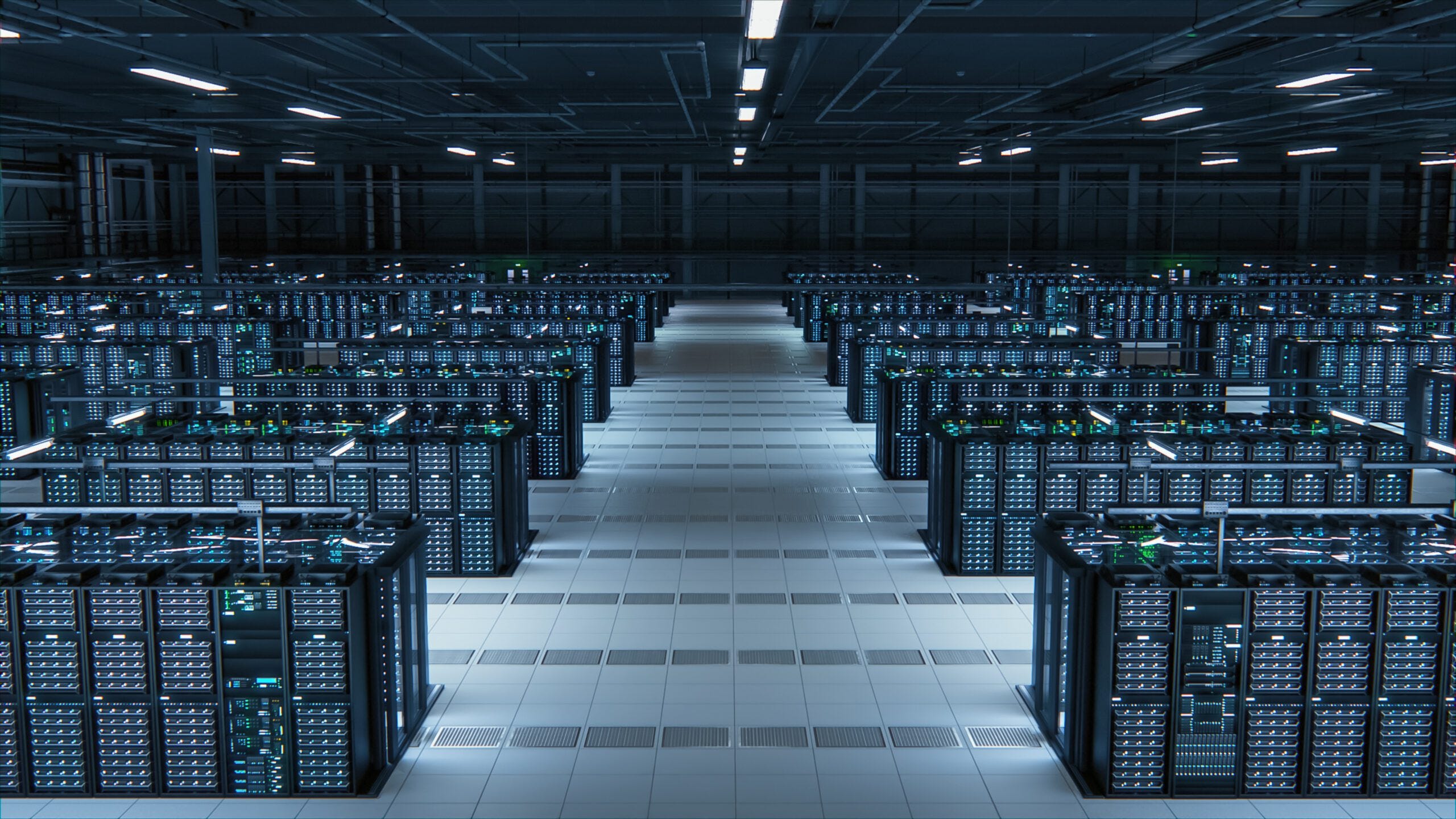
The physical data center layer includes both the cooling and power systems inside the server racks (VRT) and the real estate that houses them (EQIX, DLR). Both are gated by the same constraint: wholesale data center capacity in Northern Virginia, Phoenix, Dallas, and the new build-out regions is essentially sold out through 2028.
VRT (5%): Vertiv is the pure play on cooling and power management inside the data center. AI server racks now draw 100+ kilowatts each (a typical home runs at about 1 kW continuously), which is too much heat to remove with air. That means liquid cooling, and Vertiv is the consensus winner in both retrofits and new builds.
EQIX (3%): Equinix runs the “interconnection” services, where many companies put their servers in the same facility specifically to connect directly to each other. Once you’re in, moving out means losing all those direct connections, that’s a real network-effect moat.
DLR (3%): Digital Realty is the wholesale side: large, customized data centers built for a single big tenant. More of a commodity business, but demand has so far outstripped supply that prices have finally re-rated higher.
6. Networking (4%): ANET
ANET (4%): Arista is a bet on a specific technology transition. The high-speed networks that connect AI chips inside a data center currently run on NVIDIA’s proprietary networking technology, called InfiniBand. The bet is that over time these networks shift to Ethernet where Arista is the clear leader. Several major players are actively pushing in this direction. I keep this position smaller because the timing of when AI networks actually shift from InfiniBand to Ethernet is genuinely hard to predict.
7. Memory (3%): MU
MU (3%): Micron is the bet on HBM (high-bandwidth memory), a specialized type of memory that sits right next to each AI chip and feeds it data. HBM is the second hard bottleneck in AI chip manufacturing, after the CoWoS packaging I mentioned in the compute section. Micron is the third source behind SK Hynix and Samsung, but it’s been qualified into NVIDIA’s current HBM generation (HBM3E) and the next one (HBM4).
8. AI Software (3%): PLTR, SNOW
This is where I have the least conviction and the smallest positions.
PLTR (2%): Palantir is a bet that AIP, their AI deployment platform, becomes the default way that governments and large enterprises actually put AI models into production. The customer growth pattern, starting small with one team, then expanding across the organization, is real and accelerating. But the stock is genuinely expensive on any traditional measure.
SNOW (1%): Snowflake is the bet that the data warehouse stays the gravitational center of where companies do their AI work, and that Snowflake captures that. Adoption of their AI product (Cortex) is the metric to watch.
9. Cybersecurity (2%): PANW, CRWD

PANW (1%): Palo Alto Networks and CRWD (1%): CrowdStrike are small tracking positions on the idea that AI creates a structurally larger set of security problems: AI agents acting autonomously, AI models being stolen, models being manipulated through cleverly crafted inputs (”prompt injection”), and managing security for millions of automated identities at once. If that thesis plays out, the security companies that already sell whole platforms should capture most of the new spending. The size of these positions reflects the fact that this is more of a thesis I’m watching than one I have high conviction in.
What would change my mind
If we go four consecutive quarters with capex growing faster than AI-attached revenue and deteriorating unit economics on inference, I will trim hyperscalers, power, and semicap aggressively.
Second-order: the political economy of power. If electricity prices for industrial and residential users rise meaningfully in states hosting the largest data center clusters (Virginia, Texas, Arizona), expect regulatory pushback that could slow build-out and decompress the power names. I think this is a 2027 risk, not an immediate one.
The frame
I do not know which models, which labs, or which applications win the next decade of AI. I have priors but no real edge there. What I do have edge on is reading capital cycles, recognizing bottleneck economics, and identifying when a small number of suppliers sit at the chokepoint of a long-duration capex wave. That is the bet this portfolio expresses.
What I am actually doing is owning the entire supply chain at the layers where the supply curve is inelastic: accelerators, advanced nodes, EUV tools, gigawatt-scale power, advanced packaging, HBM, and the real estate that has to host all of it. Those layers will be rewarded by the AI capex cycle regardless of which model lab ends up on top.